

Climate change is already happening in Yellowknife. We are experiencing higher average temperatures, changes in precipitation patterns, and warmer winters than in the last several decades. That’s why it is important that we strategically adapt to our changing climate.
What does 'adaptation' mean?
"Actions that help to prevent or reduce climate change impacts and leverage any benefits of a changing climate." - Canadian Climate Institute
Current Climate
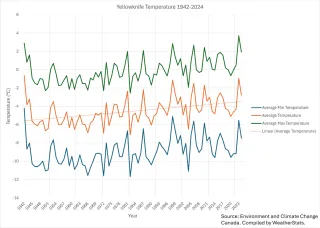
From 1942 to 2024 (82 years), Yellowknife has warmed by 2.02 °C (see the gradually increasing average temperature line in the graph below). That number is still climbing.
Projected Climate
In the coming years, Yellowknife is expected to see increasingly warmer and shorter winters, more precipitation in the form of snow, further permafrost degradation, hotter and drier summers, more intense wildfires, and more extreme weather, among other climate hazards.
Climate Atlas of Canada - Climate Change Estimates for Yellowknife, 2051-2080:
| Change | 1976-2005 Mean Temperature | 2051-2080 High-Carbon Climate Change Temperature Projections | ||
|---|---|---|---|---|
| Low | Mean | High | ||
| Typical Hottest Temperature | 28.7 | 29.0 | 32.2 | 36.4 |
| Typical Coldest Temperature | -43.6 | -45.8 | -37.3 | -33.5 |
| Number of -30 °C Days/Year | 53 | 3 | 16 | 34 |
| Number of below-zero days/year | 227 | 168 | 192 | 216 |
| Number of +25 °C Days/Year | 7 | 9 | 27 | 54 |
| Annual Precipitation (mm) | 292 | 265 | 344 | 436 |
| Frost-free season (days) | 111 | 121 | 144 | 166 |
Current Impacts
See our full Climate Vulnerability Assessment Report for more details on climate impacts in Yellowknife.
Much of Yellowknife's building stock and infrastructure was designed to historical building standards and may be incompatible with our future climate. In the Northwest Territories, potential loss of infrastructure from permafrost thaw alone is estimated at $1.3 billion over the next 75 years, causing infrastructure damage of $51 million per year.
Climate change in Yellowknife is also:
- causing productivity losses and business disruptions (e.g., due to wildfire evacuations);
- affecting people’s physical and mental health (e.g., from forest fire smoke); and
- impacting the ecosystem and the services it provides (e.g., changes to wildlife and natural areas that impact hunting and gathering on the land).
Acting proactively can help us be better prepared for, and have increased capacity to respond to, the impacts of climate change. This will help prevent disruptions to our daily lives, service delivery, and economy, and keep our community members safe.
Prevention Pays Off!
According to the Canadian Climate Institute, even small investments to reduce vulnerability can deliver broad social, economic, and environmental benefits.
Decades of Canadian insurance payouts show that the number of catastrophic weather-related events is rising and that they’re becoming more costly. In July and August of 2024, extreme weather events resulted in $7 billion of insured losses in Canada, making that year the costliest in our country’s history.
Yellowknife has already begun to experience climate change impacts firsthand:
Community-wide evacuations:
- In 2023, wildfires in the region resulted in the evacuation of 12 communities in the NWT, including approximately 20,000 people from the Yellowknife area. Insured losses in Yellowknife and Behchokǫ̀ were roughly $30 million. While no buildings were lost within the city, the evacuation of residents was costly, as were the economic losses of businesses.
- Wildfires in 2014 burned 3.4 M hectares of land in the NWT. Most residents of Hay River were forced to evacuate. Firefighting alone costs $56.1 M.
Infrastructure damage:
- Following issues with shifting land at the Yellowknife airport runway in January 2023, the GNWT commissioned a geotechnical study that determined the shifting ground conditions were caused by thawing permafrost
- In 2018, the Northern Frontier Visitor Center was forced to close due to sinking and shifting from permafrost thaw that led to structural problems
- Permafrost thaw has damaged locally paved roads, which require repairs
- Extreme cold weather has caused pipes and water mains to freeze
Disrupted services:
- In September 2022, a tree collapsed on transmission lines at Snare Hydro during a high-wind event, which resulted in two days of power outages
- Wildfires have also led to power outages, such as the city-wide power outage in July 2016, when a nearby fire damaged power lines
- Climate impacts such as snowfall and freezing rain have led to delayed public transportation and dangerous driving conditions
- Ice roads are critical for connecting Yellowknife residents and neighbouring communities. Warmer temperatures are shortening the ice road season because the ice is freezing later and thawing earlier
For more information on wildfires, prevention tips, and evacuation information, please visit the Fire Prevention page.
What Residents Can Do
What residents can do:
Year-round:
- Improve insulation in your building to prevent heat loss in the winter and heat gain in the summer (especially in attics, crawl spaces, exterior walls, and basements)
- Air seal buildings (with weather stripping or sealant) to prevent drafts and improve energy efficiency
- Improve ventilation in your building to remove moisture and pollutants
- Replace old windows and doors in your building to eliminate drafts and improve energy efficiency
- Prepare to evacuate
- Install a heat pump, air purifiers, ceiling fans, or air conditioners to maintain temperature and air quality indoors
- Protect lower floors of buildings from flooding by installing backflow prevention valves
- Install solar panels or a wood stove as a backup power source
Summer & fall:
- FireSmart your home and property
- Close your blinds and drapes during the hottest part of the day
- Check Yellowknife's Air Quality Health Index and limit outdoor time when the air quality is poor (e.g., due to wildfire smoke)
- Check out the City’s Wildfire Protection Plan
- During a heat wave, stay hydrated, wear loose-fitting clothes and stay in shaded or air-conditioned areas
- Landscape your yard and garden to encourage rain to filter into the ground and away from your building foundation
- Plant trees (away from your building) to increase shade
- Plant native and drought-tolerant species
- Grow your own food in your home, yard, or balcony
Winter & spring:
- Check out the City’s Ice Safety Information page
- Prepare your home or business for power outages
- Check out the City’s Water Line Freeze Protection Tips to prevent your pipes from freezing
- Open your blinds and drapes during the day to let in the sun and close them at night to keep the heat in
What Builders Can Do
The Standards Council of Canada has created the Northern Infrastructure Standardization Initiative, which consists of building standards to help northern communities adapt to climate change. The standards provide builders with solutions for:
- Building in permafrost;
- Dealing with extreme weather, and
- Designing with climate change and risk in mind.
Climate Justice
The City of Yellowknife recognizes that our residents are not affected equally by climate change, nor do they have equal access to resources to adapt to climate change impacts. We aim to improve equity in our community by advancing climate justice.
What does 'climate justice' mean?
It is an approach to addressing climate change that recognizes the existing inequities that are compounded by the disproportionate distribution of climate impacts on marginalized and vulnerable populations.