

Reducing Yellowknife’s GHG emissions helps keep our air clean to breathe and keeps our community members healthy – especially young children, the elderly, and people with respiratory issues.
Investing in cleaner sources of energy and improving efficiency doesn’t just help the environment, but it also helps you save money. Switching to clean energy for heating and electricity, such as biomass and solar, is becoming cheaper than traditional sources like heating oil, propane, or diesel. Improving the efficiency of buildings and transportation will also help lower your bills.
That’s why we must measure our energy use and emissions and monitor our progress towards our emissions-reduction goals as we aim to mitigate climate change.
What does 'mitigation' mean?
Reducing greenhouse gas emissions to help limit the extent of climate change.
Recent Emissions and Energy Data
The City of Yellowknife tracks corporate and community emissions and energy data. Corporate emissions include emissions from infrastructure assets managed by the City, while community emissions encompass all emissions that occur within the City’s geographic boundaries.
City of Yellowknife Community GHG Emissions Trend 2021 – 2023
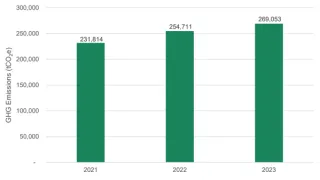
For more information on our recent energy and emissions trends, see our new GHG Emissions and Energy Inventory report.
Current Targets and Progress
The Government of the Northwest Territories has committed to reaching net-zero GHG emissions by 2050. Making up about 50% of the territory’s population, Yellowknife plays a critical role in reaching this goal.
What does 'net-zero' mean?
The total amount of emissions produced by human activities (e.g., by burning fossil fuels) is less than the amount being removed from the atmosphere (e.g., by preserving green spaces, planting trees, etc.).
What Residents Can Do
Follow these tips to improve energy efficiency in your home or business and save money on your energy and gas bills.
*Possible for some tenants
Buildings (adapted from Arctic Energy Alliance and NTPC)
- Monitor your energy use
- Get a Home Energy Evaluation, a Desktop Building Energy Audit, and even free advice from Arctic Energy Alliance
Install a drain water heat recovery system
Drain water heat recovery systems capture heat from your shower’s drain and use it to pre-heat cold water entering your home. It can save you 40% of your water heating costs!
- Install solar panels, a solar water heating system, or a wood pellet boiler
- Install an ECM for hydronic heating systems or potable water
Air seal buildings (with weather stripping and sealants) to stop drafts and improve energy efficiency
Air leakage represents 25-40% of the heat lost in an older home.
- Hang your laundry to dry instead of using the dryer
- Replace old windows and doors to improve energy efficiency
- Switch to energy-efficient appliances (look for the ENERGY STAR label)
- Add insulation to your building to prevent heat loss in the winter and heat gain in the summer (especially in attics, crawl spaces, exterior walls, and basements)
Wash your clothes in cold water
85-90% of energy used by your washing machine is to heat the water.
- Use timers or motion sensors to control outdoor lighting
- Lower your thermostat when you are away and at nighttime (or use a programmable thermostat to do so)
Switch light fixtures to LED lightbulbs
LED lighting uses 80-90% less energy than incandescent bulbs and lasts at least 10x longer.
Transportation
- Use public transit
Walk or cycle instead of driving
Save money on gas, help the environment, and improve your physical and mental health all at once!
- Use the YK Car Share Co-op electric vehicles
- Buy an electric vehicle or electric bike/scooter
- Carpool
- Use an automated vehicle plug-in controller or timer for your car’s block heater or battery blanket
Food
Eat more plant-based foods like whole grains, beans, nuts, and lentils
Plant-based foods generally use less energy, land, and water to grow - and result in fewer GHG emissions - than animal products.
- Grow your own food in your home, yard, or balcony (check out our Local Food Production page)
- Buy locally sourced food (e.g., from the farmers' market or fresh-caught fish)
- Compost food and organic waste
- Reduce methane emissions at the landfill by putting your food scraps in the green bin