

The story of Yellowknife stretches from time immemorial through eras of exploration, gold discovery, Indigenous stewardship, and modern development.
This page highlights key moments in the region’s history and the heritage sites that preserve its past.
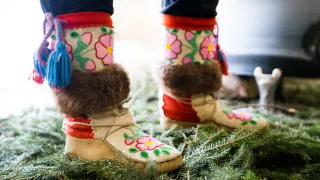
The story of Yellowknife cannot be captured in a single burst, but in a series of fiddle strokes, carvings, multi-beaded hues, and fish scales – the rest has yet to be written.
Early History & Indigenous Stewardship
- Before a city was erected, the Wiiliideh Yellowknives Dene lived in harmony with the land.
- Hunting, trapping, fishing, gathering berries, and wood have been a way of life since time immemorial.
- European settlers named the river “Yellowknife” after the copper tools carried by the Dene in the 1700s.
- The Dene translation for Yellowknife River means “toothless fish river.”
Exploration Era (1700s – 1800s)
In 1770, Hudson’s Bay Company explorer Samuel Hearne visited the area.
Peter Pond (1786) and Alexander Mackenzie (1789) followed.
- The Northwest Company established Fort Providence near Wool Bay, south of present-day Yellowknife.
- Over the following century, new relationships formed between the Dene, settlers, and Métis communities around Great Slave Lake.
Gold Mining & Rapid Growth (1930s – 1950s)
- The 1930s brought a wave of exploration, leading to the discovery of gold.
- By 1938, three gold mines were operating, and hundreds of new settlers had arrived.
- Yellowknife grew from small shacks, log cabins, and tents into a fast-growing settlement.
Becoming a City (1953 – 1970)
- In 1953, Yellowknife became a Municipal District.
- It was recognized as a city on January 1, 1970.
- Yellowknife was formally established as the capital of the Northwest Territories in 1967.
Modern Era
- Today, diamonds are mined from the Canadian Shield.
- Ice roads and northern aviation (including vintage aircraft) continue to support surrounding communities.
- The ongoing story of Yellowknife lives in its culture, art, traditions, and the people who shape its future.
The Story Behind Yellowknife’s Coat of Arms and What It Represents
Did you know that Yellowknife's Coat of Arms was created through a public competition?
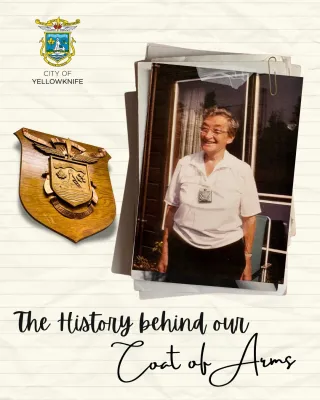
In the mid-1950s, the Municipal District of Yellowknife organized a public competition to design a municipal coat of arms, inviting submissions to capture the essence of the growing northern community. The winning design was submitted by Netta Pringle, who received a prize of $25 for her artwork.
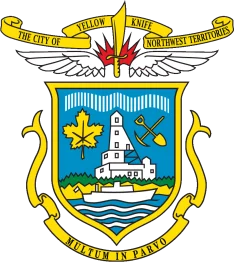
Officially adopted by Council on June 27, 1956, the crest captured the spirit of Yellowknife at a pivotal moment in its history.
Look closely and you'll find pieces of our story woven throughout the design. The mining tools and headframe recognize the gold mining industry that helped establish the city. The trees, rocks, and waves reflect the surrounding landscape and Great Slave Lake. The aurora, midnight sun, and maple leaf celebrate our place in Canada's North, while the yellow knife above the shield honours the Yellowknives Dene First Nation and the origin of our city's name.
The motto, Multum in Parvo -"many things in a small place"- was submitted by Ted Horton and remains just as meaningful today as it was 70 years ago.
Netta's original design, carved in mahogany with copper accents, still hangs in City Hall as a reminder of the vision that helped shape one of Yellowknife's most recognizable symbols.
As we celebrate the 70th anniversary of the Coat of Arms, we're reminded that the story of Yellowknife continues to be written by the people who call this place home. While much has changed since 1956, the pride, resilience, and sense of community reflected in the crest remain part of who we are today.